Showing posts with label Fort. Show all posts

Wednesday, October 11, 2017

Part 3: MP & UP Trip - Orchha


11-Oct-17            Wednesday       5              Orchha –

Took a Auto for Orchha, and reached around 11.30 am. Refreshed had our lunch and started citi tour by walk around 2.30 pm

Orchha

From Agra/Delhi/Gwalior: Take a train to Jhansi station, and then you have two options. The easier but more expensive option is you can hire a car or auto-rickshaw to Orchha which is 15KM away. By auto-rickshaw, it takes about 40 minutes; by car, 20 minutes. The listed price at the pre-paid taxi stand was 200 rupees, however, you'll have to negotiate the price with the driver that you take. A cheaper way is to pile into one of the auto-rickshaws outside the train station which serve as a bus shuttle-- see if it's going to the bus station, which should only cost 10 rupees this way. From the bus station there are other shuttle auto-rickshaws that head to Orchha for 20 rupees per person, though you might have to wait a few minutes till it leaves; they only go when full.

You can reach Orchha while returning to Jhansi from Khajuraho, as a detour. While coming to Jhansi from Khajuraho, when you reach on the outskirts of Jhansi city, take left on the Orchha Tigaila(triangle). That road will lead to Orchha. There is a small railway station at Orchha in which only very few trains stop. Jhansi - Khajuraho Passenger(229A) has stoppage at Orchha. Khajuraho - Jhansi passenger (230A) reaches Orchha by 4:45Pm. Orchha railway station is 5Kms away from Orchha town and is about an hours brisk wait. Go North and out of town and continue straight until you cross the train track and its right on the left. Hire a rickshaw and pay Rs. 50 max to get to Orchha train station.

To go Khajuraho from Orchha by train. There is a 07.25 passenger train taking 5 hrs. Train 19666, buy a general ticket which is around 35 Rupee. Be careful however as the train may split at a junction station with half the carriages going to Khajuraho and the rest somewhere else. Towards the back of the train should be safe as the train passes the turnoff before it splits and the new train reverses direction.

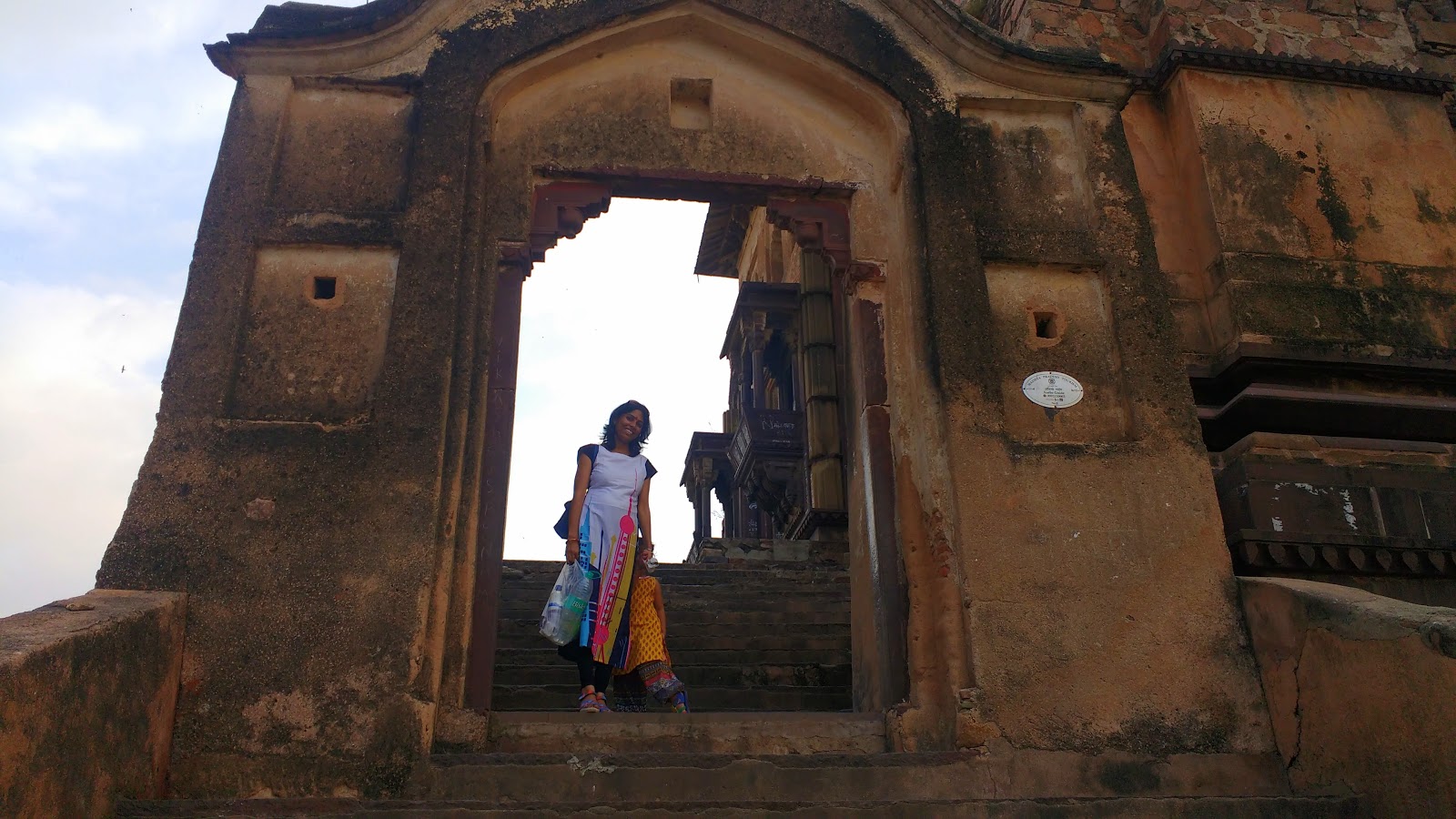
Orchha is a tiny farming town dotted with historical sites. Of note:


Fort Complex: The fort complex is a great place to visit; hit this first to obtain an all-day ticket good for all the sights in Orchha. Divided into 3 parts, it consists of


Raj Mahal: Situated to the right of the quadrangle, this palace was built in the 17th century by Madhukar Shah, the deeply religious predecessor of Bir Singh Ju Deo. The plain exteriors, crowned by chhatris, give way to interiors with exquisite murals, boldly colourful on a variety of religious themes. Get a good guide inside here to take you all over the complex, including locked rooms, for a tip.


Jehangir Mahal: Built by Raja Bir Singh Ju Deo in the 17th century to commemorate the visit of Emperor Jehangir to Orchha. Its strong lines are counterbalanced by delicate chhatris and trellis work, the whole conveying an effect of extraordinary richness.


Sunder Mahal: This small palace, almost in ruins today is still a place of pilgrimage for Muslims. Dhurjban, son of Jhujhar, embraced Islam when he wed a Muslim girl at Delhi. He spent the latter part of his life in prayer and meditation and came to be revered as a saint.
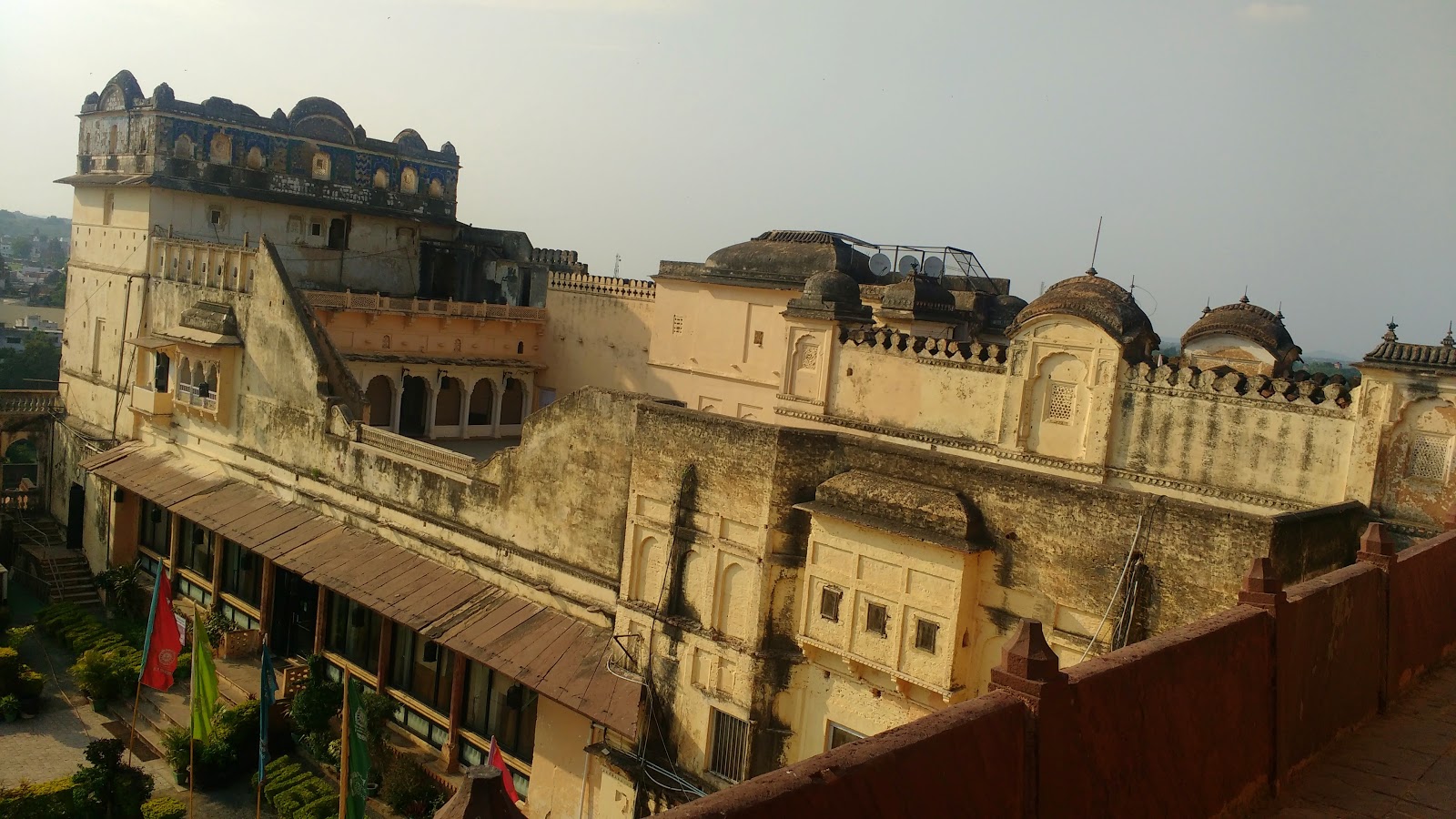


Rai Parveen Mahal: Poetess and musician, Rai Parveen was the beautiful paramour of Raja Indramani (1672- 76) and was sent to Delhi on the orders of the Emperor Akbar, who was captivated by her. She so impressed the Great Mughal with the purity of her love for Indramani that he sent her back to Orchha.


Phool Bagh: Laid out as a formal garden, this complex testifies to the refined aesthetic qualities of the Bundelas. A central row of fountains culminates in an eight pillared palace-pavilion. A subterranean structure below was the cool summer retreat of the Orchha kings. An ingenious system of water ventilation connects the underground palace with Chandan Katora, a bowl-like structure from whose fountains droplets of water filtered through to the roof, simulating rainfall.


Laxminarayan Temple: A flagstone path links this temple with the Ram Raja Temple. The style is an interesting synthesis of fort and temple moulds. The interiors contain the most exquisite of Orchha's wall paintings. Covering the walls and ceiling of three halls, these murals are vibrant compositions and cover a variety of spiritual and secular subjects. They are in excellent state of preservation, with the colours retaining their vivid quality.


Ram Raja temple (closed during the afternoon): This is the center around which the life of Orchha revolves. The presiding Deity here is Lord Ram. The idols were meant to be installed in the magnificent Chaturbhuj temple, but when the idols, once kept on the ground(where they are today), refused to move. So a makeshift temple was built around it and is known as Ram Raja temple. It has an excellent courtyard, tiled with marble and the temple in pink and yellow colors, gives a bright look. No cameras or bags allowed inside.


Chaturbhuj Temple: Built upon a massive stone platform and reached by a steep flight of steps, the temple was specially constructed to enshrine the image of Rama that remained in the Ram Raja Temple. Lotus emblems and other symbols of religious significance provide the delicate exterior ornamentation. Within, the sanctum is chastely plain with high, vaulted walls emphasizing its deep sanctity. Find the hidden stairs to the roof for a view of the entire area. The young keyholder will unlock the door to the hidden stairs and take you up for some money and show you around which he supposed to do for free.


Cenotaphs: There are 14 Chhatris or Memorials to the rulers of Orchha, grouped along the Kanchan Ghat of the river Betwa on the south end of town. You can climb up to the roof for views of the river.


12-Oct-17            Thursday             6              Gwalior

After having our breakfast Started around 7AM

Thursday, February 16, 2017

Part 2 : UP Trip ( Agra - Fathepur sikri - Delhi)

Part 2 : UP Trip ( Agra - Fathepur sikri - Delhi)


Day 6(Tue)-14 Feb 2017 - Agra- (Night -Agra)


TajMahal

Please note that the Taj Mahal is closed every Friday.

'If you buy the foreigner high price ticket, you go in a separate, much smaller line and they give you shoe covers and water. Touts (tour guides) will say they can cut the line because they're guides, but you get in the smaller line anyway with your 750 Rupee ticket.'
The Taj Mahal is an immense mausoleum of white marble, built between 1631 and 1648 by order of the Mughal emperor Shah Jahan in memory of his favourite wife. Taj Mahal means Crown Palace. One of his wife's names was Mumtaz Mahal, Ornament of the Palace. The Taj is one of the most well preserved and architecturally beautiful tombs in the world, one of the masterpieces of Indian Muslim architecture, and one of the great sites of the world's heritage.
The Taj Mahal has a life of its own that leaps out of marble, provided you understand that it is a monument of love. The Indian poet Rabindranath Tagore called it a teardrop on the cheek of eternity, while the English poet, Sir Edwin Arnold, said it was Not a piece of architecture, as other buildings are, but the proud passions of an emperor's love wrought in living stones. It is a celebration of woman built in marble, and that is the way to appreciate it.


Although it is one of the most photographed edifices in the world and instantly recognisable, actually seeing it is awe-inspiring. Not everything is in the photos. The grounds of the complex include several other beautiful buildings, reflecting pools, extensive ornamental gardens with flowering trees and bushes, and a small gift shop. The Taj framed by trees and reflected in a pool is amazing. Close up, large parts of the building are covered with inlaid stonework.
There is an apocryphal tale that Shah Jahan planned to build an exact copy of the Taj Mahal out of black marble on the opposite side of the river as his own tomb. His plans were foiled by his son, who murdered three elder brothers and overthrew his father to acquire the throne. Shah Jahan is now buried alongside his wife in the Taj Mahal.


If you are taking a camera, beware that because the Taj is white your camera may underexpose your photos. If it is a film camera you will not find out until it is too late. Overexposure by 1 or 2 stops is recommended.
The Taj is open from 6:00 AM to 6:30 PM (sunset) every day except Friday. The gates won't open until 6:00 AM at the earliest, often a few minutes later, so don't bother getting there at 5:00 AM. Entry costs ₹750 for foreigners and ₹20 for Indians. Get there as early as possible to beat the crowds. Crowds are the biggest during the weekend when people overshadow the grandeur of the Taj. Plan to visit the Taj at least two different times during the day (dusk and dawn are best) in order to experience the full effect of changing sunlight on the amazing building. It is utterly stunning under a full moon. You can also get very good views from Mehtab Bagh (see Gardens section below). It is a good idea to bring a flashlight, because the interior of the Taj Mahal is quite dark even during the day. To fully appreciate the details of the gem inlays, you need a good light.
To buy tickets, you can go to the South gate, but this gate is 1 km far away of the entrance and the counter opens at 8:00 AM. At the West and East gates, the counters open at 6:00 AM. These gates also have smaller queues in peak times as the big tour buses drop groups off at the South gate. Alongside the ticket counter, you can also purchase a self-guided audio tour (allows two to a device) for ₹100 in English and foreign languages and ₹60 for Indian languages.
The Taj is located in the middle of town. Expect a line to get into the grounds. There are three gates. The western gate is the main gate where most tourists enter. A large number of people turn up on weekends and public holidays, and entry through the western gate may take hours. The southern and eastern gates are much less busy and should be tried on such days.
There are night viewing sessions during full moons and two days before and after (five days in total). Exceptions are Fridays (the Muslim sabbath) and the month of Ramadan. Tickets must be purchased 24 hours in advance from the Archeological Society of India office situated at 22, Mall Road, Agra. Ticket fare is Rs. 500 for Indian Nationals and Rs. 750 for Non Indians. Night tickets go on sale starting at 10am, but they do not always sell out, so it can be worth looking into it when you arrive even if well after 10am. Tickets only allow viewing from the red sandstone plaza at the south end of the complex, and only for a 1/2 hour window. Make sure to wear mosquito repellent. Viewing hours for night viewing is from 8:30pm-9:00pm and 9:00pm-9:30pm. Arrive 30 minutes early for security check at Taj Mahal Ticketing counter on East Gate or you may lose your chance. The night view is not worth spending as the visitors are kept quite far from Taj Mahal nearly 200 Mts away and there in no light so it could hardly be seen during night hours at viewing hours. Cameras also do not give images with near zero flux can easily be avoided for night viewing.

Agra Fort


The fort is similar in layout to the Red Fort in Delhi, but considerably better preserved, as much of Delhi Fort was razed by the British after the Mutiny. As much as palace as a defensive structure, it is also constructed mainly from red sandstone.
Emperor Akbar, king at 14, began consolidating his empire and, as an assertion of his power built the fort in Agra between 1565 and 1571, at the same time as Humayun's Tomb in Delhi. Emperor Shah Jahan added to the fort and ended up a prisoner in it. The fort has a beautiful view of his masterpiece, the Taj Mahal, on a clear day.

You can get to the fort by Rickshaw from Taj Mahal for around ₹25-30. Entry to the fort is ₹500(SEP 2016) (plus levy of ₹50 if you have not already paid the ₹500 fee for Taj Mahal).


There are left luggage services at Agra Fort where you can stow your bags at no cost. A fine of ₹5,000 applies if you lose your luggage ticket.


There are also audio guides available at Agra Fort which you can rent for a cost of ₹100 in English and other foreign languages (German, French, Spanish, etc) or ₹60 in Indian languages such as Hindi or Bengali.

Stay at Agra

Day 7(Wed)-15 Feb 2017- Agra - (Night -Agra)


Fatehpur Sikri – 2 hours


Fatehpur Sikri is a UNESCO world heritage site. Built in the the 16th century by the Emperor Akbar, Fatehpur Sikri (the City of Victory) was the capital of the Mughal Empire for about 10 years. Then it was abandoned for reasons that are still something of a mystery. It includes one of the largest mosques in India, the Jama Masjid. It is full of well preserved palaces and courtyards, and is a must see for anyone visiting Agra. In order to get a full idea of this site it is better to take a guide (₹300 for 2 hours for its charge-less entrance part) or have a good printed guide. The entrance to the site (even to the yard) is only without shoes.


Sikandara (Akbar's Tomb) – 1 hours


(10 km north of Agra on the Agra Delhi highway). Open from sunrise to sunsetThe tomb of Akbar lies here in the centre of the large garden. Akbar started its construction himself but it was completed by his son Jehangir, who significantly modified the original plans which accounts for the somewhat cluttered architectural lines of the tomb. Four red sandstone gates lead to the tomb complex: one is Muslim, one Hindu, one Christian, and one is Akbar's patent mixture.


Mariam's Tomb (near Sikandara),

(West from Akbar's Tomb on Agra-Delhi highway). Constructed by Jahangir in the memory of his mother Mariam Zammani a title bestowed upon her,. The grave is made of white marble. Though this building is in a ruined condition, yet it has in its vicinity, a Christian Mission School and a church. It is also said; Akbar himself made that it in the memory of his Christian wife


Eaitmad-ud-daula (Baby Taj)

Empress Nur Jehan built Itmad-Ud-Daulah's Tomb, sometimes called the Baby Taj, for her father, Ghias-ud-Din Beg, the Chief Minister of Emperor Jahangir. Small in comparison to many other Mughal-era tombs, it is sometimes described as a jewel box. Its garden layout and use of white marble, pietra dura, inlay designs and latticework presage many elements of the Taj Mahal


  1. Mehtab Bag (Moonlight Garden)
Stay at Agra

Day 8(Thus) –16 Feb 2017- (Delhi)