11-Oct-17 Wednesday 5 Orchha –
Took a Auto for Orchha, and reached around 11.30 am.
Refreshed had our lunch and started citi tour by walk around 2.30 pm
Orchha
From Agra/Delhi/Gwalior:
Take a train to Jhansi station,
and then you have two options. The easier but more expensive option is you can
hire a car or auto-rickshaw to Orchha which is 15KM away. By auto-rickshaw, it
takes about 40 minutes; by car, 20 minutes. The listed price at the pre-paid
taxi stand was 200 rupees, however, you'll have to negotiate the price with the
driver that you take. A cheaper way is to pile into one of the auto-rickshaws
outside the train station which serve as a bus shuttle-- see if it's going to
the bus station, which should only cost 10 rupees this way. From the bus
station there are other shuttle auto-rickshaws that head to Orchha for 20
rupees per person, though you might have to wait a few minutes till it leaves;
they only go when full.
You can reach Orchha while returning to Jhansi from Khajuraho,
as a detour. While coming to Jhansi from Khajuraho, when you reach on the
outskirts of Jhansi city, take left on the Orchha Tigaila(triangle).
That road will lead to Orchha. There is a small railway station at Orchha in
which only very few trains stop. Jhansi - Khajuraho Passenger(229A) has
stoppage at Orchha. Khajuraho - Jhansi passenger (230A) reaches Orchha by
4:45Pm. Orchha railway station is 5Kms away from Orchha town and is about an
hours brisk wait. Go North and out of town and continue straight until you
cross the train track and its right on the left. Hire a rickshaw and pay Rs. 50
max to get to Orchha train station.
To go Khajuraho from Orchha by train. There is a 07.25
passenger train taking 5 hrs. Train 19666, buy a general ticket which is around
35 Rupee. Be careful however as the train may split at a junction station with half
the carriages going to Khajuraho and the rest somewhere else. Towards the back
of the train should be safe as the train passes the turnoff before it splits
and the new train reverses direction.
Orchha is a tiny farming town dotted with historical sites. Of note:

Fort Complex: The fort
complex is a great place to visit; hit this first to obtain an all-day ticket
good for all the sights in Orchha. Divided into 3 parts, it consists of


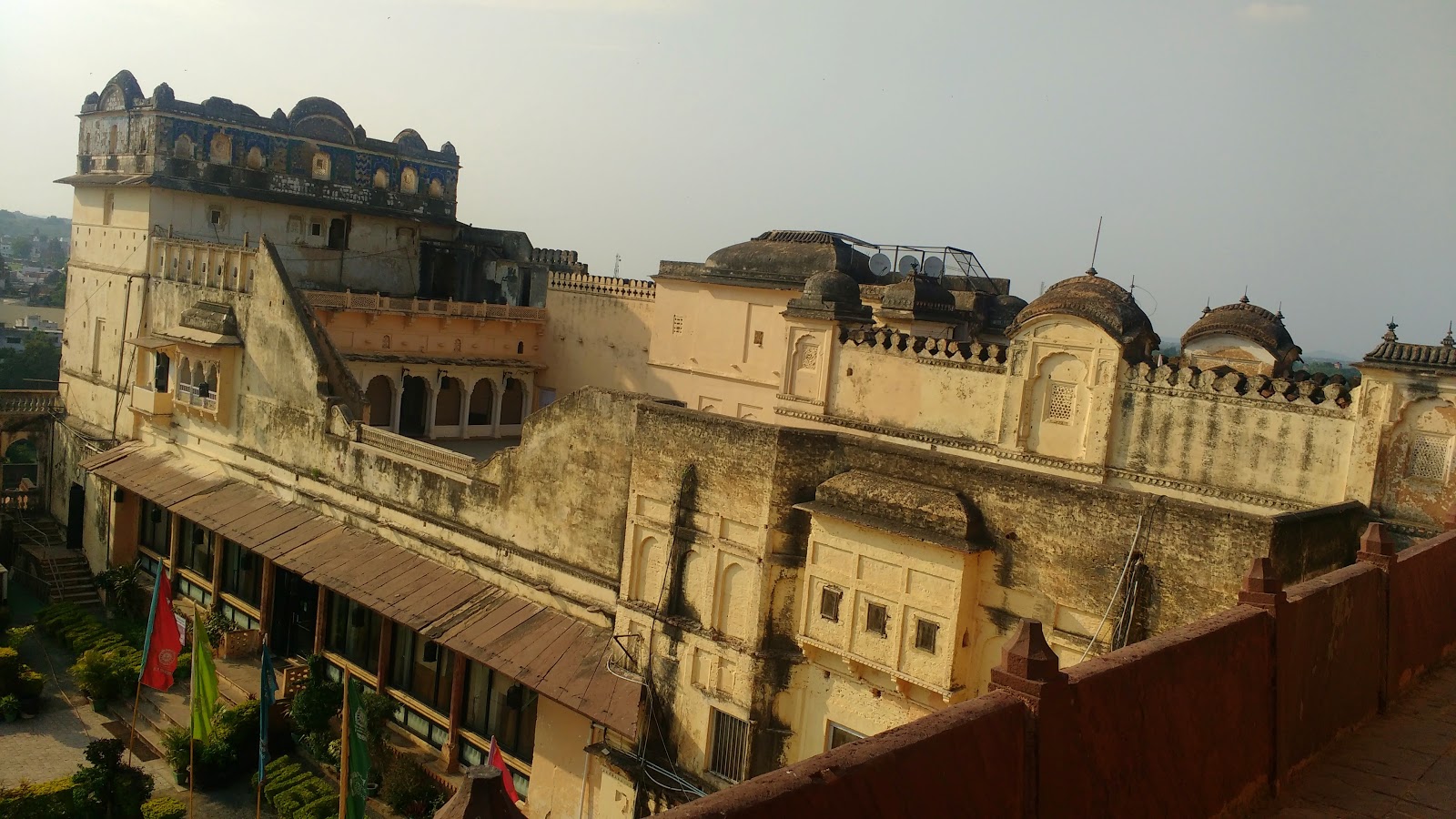
Raj Mahal: Situated
to the right of the quadrangle, this palace was built in the 17th century by
Madhukar Shah, the deeply religious predecessor of Bir Singh Ju Deo. The plain
exteriors, crowned by chhatris, give way to interiors with exquisite murals,
boldly colourful on a variety of religious themes. Get a good guide inside here
to take you all over the complex, including locked rooms, for a tip.


Jehangir Mahal: Built by
Raja Bir Singh Ju Deo in the 17th century to commemorate the visit of Emperor
Jehangir to Orchha. Its strong lines are counterbalanced by delicate chhatris and
trellis work, the whole conveying an effect of extraordinary richness.


Sunder Mahal: This small palace, almost in ruins today is still a place of pilgrimage for Muslims. Dhurjban, son of Jhujhar, embraced Islam when he wed a Muslim girl at Delhi. He spent the latter part of his life in prayer and meditation and came to be revered as a saint.
Rai Parveen Mahal: Poetess and musician, Rai Parveen was the beautiful paramour of Raja Indramani (1672- 76) and was sent to Delhi on the orders of the Emperor Akbar, who was captivated by her. She so impressed the Great Mughal with the purity of her love for Indramani that he sent her back to Orchha.

Phool Bagh: Laid out as a formal garden, this complex testifies to the refined aesthetic qualities of the Bundelas. A central row of fountains culminates in an eight pillared palace-pavilion. A subterranean structure below was the cool summer retreat of the Orchha kings. An ingenious system of water ventilation connects the underground palace with Chandan Katora, a bowl-like structure from whose fountains droplets of water filtered through to the roof, simulating rainfall.

Laxminarayan Temple: A flagstone path links this temple with the Ram Raja Temple. The style is an interesting synthesis of fort and temple moulds. The interiors contain the most exquisite of Orchha's wall paintings. Covering the walls and ceiling of three halls, these murals are vibrant compositions and cover a variety of spiritual and secular subjects. They are in excellent state of preservation, with the colours retaining their vivid quality.
Ram Raja temple (closed during the afternoon): This is the center around which the life of Orchha revolves. The presiding Deity here is Lord Ram. The idols were meant to be installed in the magnificent Chaturbhuj temple, but when the idols, once kept on the ground(where they are today), refused to move. So a makeshift temple was built around it and is known as Ram Raja temple. It has an excellent courtyard, tiled with marble and the temple in pink and yellow colors, gives a bright look. No cameras or bags allowed inside.


Cenotaphs: There
are 14 Chhatris or Memorials to the rulers of Orchha, grouped along the Kanchan
Ghat of the river Betwa on the south end of town. You can climb up to the roof
for views of the river.


12-Oct-17 Thursday 6 Gwalior
After having our breakfast Started around 7AM